Chromium: food occurrence and limits of evidence
Chromium occurs in foods, but its classification as essential has changed over time. Explore chemical forms, variable food content, and the limits of claims about metabolism.
3 min read
Understand the nutrient
Chromium shows why nutrition education must follow changing science. It occurs in foods and in older lists of essential nutrients, but that classification needs context. Understanding the difference between presence, a proposed role, and demonstrated benefit helps avoid exaggerated claims about metabolism.
What it does
Choose an icon to explore its role. Use the arrow keys to move between icons.
Read the evidence
Distinguishing a proposed metabolic role from demonstrated benefit helps interpret product claims without assigning outcomes to a meal.
A closer look
A classification that has changed
NIH currently reports that scientists do not consider chromium necessary for good health. Historical intake recommendations were established when it was considered essential. That explains its appearance in tables and supplements without demonstrating an individual need. This guide presents the uncertainty instead of turning an older classification into a rule for meals.
Food and industrial forms are different
Trivalent chromium, called chromium III, is the form discussed in food composition. Hexavalent chromium, or VI, is a toxic form associated with industrial processes. Similar names do not make these exposures equivalent. When reading, check which form a source means and avoid transferring risks or proposed benefits between different contexts.
Amounts vary and do not predict outcomes
Soil, water, animal feed, and processing equipment can influence chromium in foods. A source list cannot calculate meal content without specific data. It also cannot demonstrate weight loss, blood sugar control, or a supplement effect. Research on these uses does not support automatic promises for someone choosing a meal.
Where to find it
Open each food to understand its connection with this nutrient.
Meat
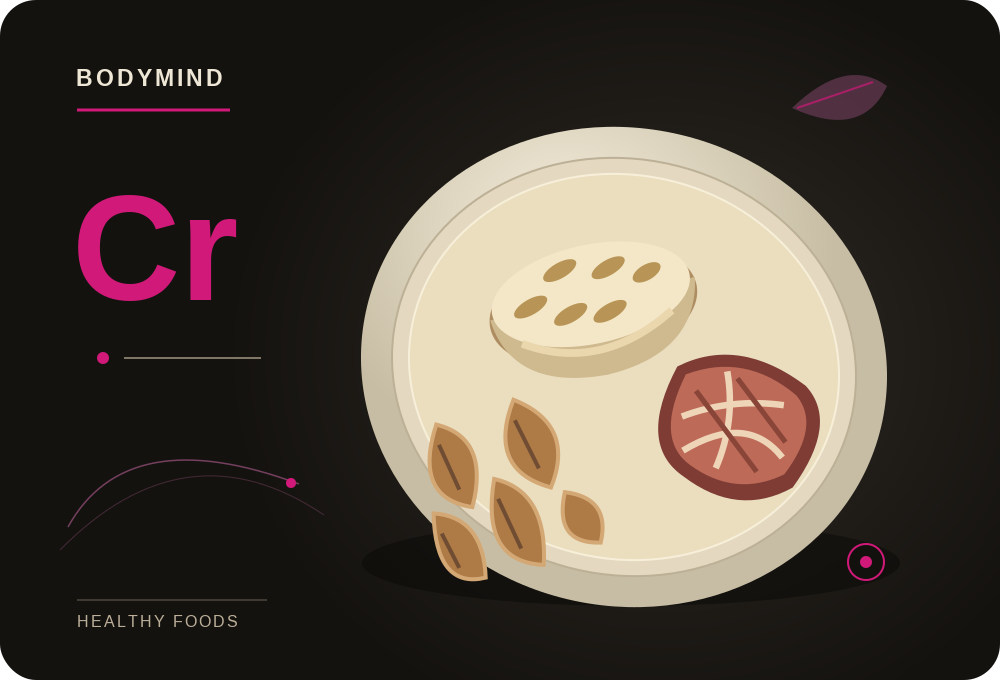
May contain chromium, but production factors affect content; the name of a cut does not establish an exact amount.
Bread and grains
Are examples listed as food sources. Compare the product and portion without treating mineral presence as a universal advantage.
Fruit and vegetables
Apples, bananas, lettuce, and green beans illustrate source variety; growing conditions can change composition results.
In your diet
NIH currently reports that scientists do not consider chromium necessary for good health. Older lists and supplement availability do not establish an individual need, weight loss, or blood sugar control.
Ideas for everyday meals
- Check when an intake recommendation or classification was published and look for institutional updates.
- Choose varied meals for their overall composition rather than chromium claims about losing weight.
- Keep a value unknown when no analysis matches the recipe ingredients and their amounts.
Myth or fact?
More chromium in a meal always means better metabolism.
What to understand
A larger amount does not establish benefit. Classification and proposed roles involve uncertainty, and weight-loss or treatment claims are not conclusions from a food table.
Common questions
Is chromium a vitamin?
No. It is a mineral element. Even its classification as an essential nutrient needs historical context because current scientific assessment should not be confused with older lists.
Does a chromium food control blood sugar?
That promise cannot be made. Food composition does not establish a treatment effect, and supplement research cannot be transferred directly to an individual meal.
Does missing data mean deficiency?
No. It only means the reference does not quantify the element in that composition. An absent number does not establish a health problem or a need for supplements.
Further reading
Institutional references behind this guide.
Keep exploring
Nutrients work together. Explore other parts of that relationship.